
Showing posts with label History. Show all posts
Showing posts with label History. Show all posts
Sunday, 15 April 2012
Venezuela Carnival History

U.S Virgin Islands Carnival History

In the mid-1600s and 1700s Europeans from countries such as Spain, Portugal, France, England and Denmark colonized the islands of the Caribbean. They brought with them the celebrations and festivals that were familiar and naturally tried to replicate the familiar in the New World. European celebrations included religious holidays and came in a variety of forms such as dress balls, parties, house to house visits and street processions. European nations sought the islands for developing plantations and the primary source of labor was enslaved Africans from West and Central Africa. They too brought with them the celebrations and festival traditions that were familiar and tried, often with difficulty, to replicate them. Their festivals were organized around certain deities or spirits, to mark a transition in life or in the community and in recognition of changes in seasons whether related to climate or to agricultural production. They incorporated a variety of forms, quite often including singing or chanting, drumming, masking and a form of street theater with performer and audience participation.
Africans brought to the Caribbean the knowledge of how to make the items they used in festivals like drums and masks, and their uses. With this they could reproduce such items. In the U.S. Virgin Islands (formerly the Danish West Indies) for example, Africans made drums using just a skin stretched over a calabash or a small barrel. An empty pot also did the job. Traditional African drumming and dances however were often feared by Europeans. They thought these might be used to communicate secretly and to plan uprisings. Drumming was often banned and other laws tried to deny Africans of their cultural identity. They were often expected to abandon their own traditions and adopt at least part of the European culture.
Indeed enslaved Africans in the Caribbean were exposed to European celebrations and festival traditions, but they generally were not allowed to participate directly. European planters and their associates celebrated amongst themselves. In some cases missionaries were responsible for introducing religious holidays and related traditions to the enslaved Africans. In the face of being introduced to new traditions and having bans on old traditions, enslaved Africans persevered. They came from different parts of Africa and therefore had different traditions, but they extracted and reinvented things from collective memories. They were able to maintain some of these traditions by fitting them into accepted European festival and holiday framework. During holidays, like Christmas and New Years, enslaved people would usually have time off and an opportunity to celebrate. These times of celebration created momentum for the cultural fusion of the two groups’ traditions and for the development of new ones. African traditions were also maintained through concessions of plantation owners and in secret.
 A
great example of the cultural fusion that took place is to look at two
popular dances considered to be U.S. Virgin Islands folk dances. The
(European) quadrille is a popular old-time dance. It is maintained today
through dance groups. It is said that plantation owners would
occasionally call on members of the enslaved African community, the ones
known to be good musicians, to entertain at parties. Perhaps in this
way the dance passed along. Another dance once popular and still
preserved in the U.S. Virgin Islands is the (African) bamboula. As
previously noted African dances and the drumming that went with them
were feared and often banned. Historical accounts from the late 1700’s
however indicate that talented dancers from amongst the enslaved people
were sometimes brought to the plantation house to perform. This shows
that the African dance tradition was being maintained, likely in secret
and eventually, at least on some plantations, it was accepted.
A
great example of the cultural fusion that took place is to look at two
popular dances considered to be U.S. Virgin Islands folk dances. The
(European) quadrille is a popular old-time dance. It is maintained today
through dance groups. It is said that plantation owners would
occasionally call on members of the enslaved African community, the ones
known to be good musicians, to entertain at parties. Perhaps in this
way the dance passed along. Another dance once popular and still
preserved in the U.S. Virgin Islands is the (African) bamboula. As
previously noted African dances and the drumming that went with them
were feared and often banned. Historical accounts from the late 1700’s
however indicate that talented dancers from amongst the enslaved people
were sometimes brought to the plantation house to perform. This shows
that the African dance tradition was being maintained, likely in secret
and eventually, at least on some plantations, it was accepted.
Music and dance were integral parts of celebrations during the plantation era in the Caribbean. These traditions continued to evolve over time; as did the various periods of celebration. Though most celebrations occurred around Christmas and the pre-lent festival of Carnival some were planned around the agricultural cycle, the end of the sugar cane harvest for example. It is from these various festivals with their creolized music, dance and masquerading traditions that Carnival developed.
Today Carnival is celebrated across the Caribbean. On some islands the festival has endured almost annually since the 1800s. On other islands the 1900s saw various festival traditions being revived into Carnival, often incorporating elements from neighboring islands. Carnival is however much more than a modern festival with remnants of contributing traditions, both European and African. While retaining similarities it has evolved into something that is also different – enough so to be considered uniquely Caribbean.
Carnival in the U.S. Virgin Islands
 St. Thomas:
The first Carnival in St. Thomas was on February 14, 1912 and the
second in 1914 – both while the islands were part of the Danish West
Indies. The early Carnival celebrations included activities that are
part of current Carnivals like bands, Carnival queen, special games and a
parade. After 1914 it would be 38 years before there was another
Carnival on St. Thomas. During this time music, masquerading and dancing
continued on special days, holidays and other events. Some of these
traditions began to lose some ground as they competed with new trends
brought to the island by immigration and travel. In 1952 a radio
personality named Ron De Lugo was reminiscing about festival traditions.
De Lugo sent out a call that there should be a Carnival. Some people in
the community did not think it was a good idea, the population was very
aware of class distinctions and there wasn’t much social life between
them. De Lugo many years later in an interview noted that on Carnival
parade day he feared that no one would show up. But people did show up,
and Carnival has been going annually ever since. Over the years
additional elements have been added. It is currently a three week event
taking place in April and is called V.I. Carnival.
St. Thomas:
The first Carnival in St. Thomas was on February 14, 1912 and the
second in 1914 – both while the islands were part of the Danish West
Indies. The early Carnival celebrations included activities that are
part of current Carnivals like bands, Carnival queen, special games and a
parade. After 1914 it would be 38 years before there was another
Carnival on St. Thomas. During this time music, masquerading and dancing
continued on special days, holidays and other events. Some of these
traditions began to lose some ground as they competed with new trends
brought to the island by immigration and travel. In 1952 a radio
personality named Ron De Lugo was reminiscing about festival traditions.
De Lugo sent out a call that there should be a Carnival. Some people in
the community did not think it was a good idea, the population was very
aware of class distinctions and there wasn’t much social life between
them. De Lugo many years later in an interview noted that on Carnival
parade day he feared that no one would show up. But people did show up,
and Carnival has been going annually ever since. Over the years
additional elements have been added. It is currently a three week event
taking place in April and is called V.I. Carnival.
 St. Croix:
St. Croix’s Carnival is called the Crucian Christmas Festival and it
became an annual event in 1952 with the revival of old holiday
traditions transformed into modern Carnival. Dating back at least to the
early-1800s enslaved Africans on St. Croix were allowed to celebrate
Christmas and New Years. The celebrations on plantations included
drumming, singing and dancing. In the main towns it involved parading
through the streets of town singing, dancing and playing drums; often
stopping door to door for rum and wine. Masquerading was popular during
Christmas and other holidays including Easter and Whit Monday. These
traditions continued into the early 1900s but saw some decline. Social
events kept music traditions and dances like the quadrille, lancers and
bomboula alive. The Carnival festival collected traditions into one big
event with a focus on the former holiday celebrations. The event has
become more and more organized each year and has incorporated additional
events. Today it last about four weeks starting in December and ending
with the parades in January.
St. Croix:
St. Croix’s Carnival is called the Crucian Christmas Festival and it
became an annual event in 1952 with the revival of old holiday
traditions transformed into modern Carnival. Dating back at least to the
early-1800s enslaved Africans on St. Croix were allowed to celebrate
Christmas and New Years. The celebrations on plantations included
drumming, singing and dancing. In the main towns it involved parading
through the streets of town singing, dancing and playing drums; often
stopping door to door for rum and wine. Masquerading was popular during
Christmas and other holidays including Easter and Whit Monday. These
traditions continued into the early 1900s but saw some decline. Social
events kept music traditions and dances like the quadrille, lancers and
bomboula alive. The Carnival festival collected traditions into one big
event with a focus on the former holiday celebrations. The event has
become more and more organized each year and has incorporated additional
events. Today it last about four weeks starting in December and ending
with the parades in January.
St. John: The Carnival celebrations on St. John have triple celebration power. It is Carnival and it takes place during two important holidays; Emancipation Day - a local holiday commemorating the abolition of slavery and 4th of July/Independence Day - the U.S. holiday commemorating independence. In 1960 the 4th of July celebrations on St. John evolved into Carnival and the festival lasted more than a week. Today the event last several weeks and culminates on the 4th of July. It is called the St. John Festival.
Turks And Caicos Islands Carnival History
 Junkanoo is believed to have begun during the 16th and 17th
century. The slaves were given a special holiday at Christmas time in
which they could be with their families to celebrate the holidays with
African dance, music and costumes. This continued after emancipation and today Junkanoo has moved from a simple festival to a formal organized festival with sophisticated costumes, music and different
themes every year. This festival has reached such a great height that
they are people are comparing it to Carnival in the Carnival world's
capital, Rio de Janeiro and New Orleans in Louisiana.
Junkanoo is believed to have begun during the 16th and 17th
century. The slaves were given a special holiday at Christmas time in
which they could be with their families to celebrate the holidays with
African dance, music and costumes. This continued after emancipation and today Junkanoo has moved from a simple festival to a formal organized festival with sophisticated costumes, music and different
themes every year. This festival has reached such a great height that
they are people are comparing it to Carnival in the Carnival world's
capital, Rio de Janeiro and New Orleans in Louisiana.
Junkanoo is the greatest celebration that takes place in the Turks and Caicos Islands with street parades of masqueraders wearing colourful costumes, goatskin drums, jangling cowbells and other rhythm instruments. This festival starts in the early hours of Boxing Day, December 26th, and in the early hours of January 1st when revelers are coming back from the New Year's Eve partie
Sint Maarten Carnival History

Take loud drum and calypso beats, glittering and feathered costumes, mouthwatering food, lots of drinks and thousands of happy people, blend them all together and enjoy the most cultural festivity on St Martin/St Maarten: the Caribbean Carnival.
The island's wildest celebration, held on both sides but on different dates. The French carnival fever takes hold during Lent where 'jump-ups' and huge parades color the streets of Marigot and Grand-Case. Zouk and reggae fills every corner with performances from popular local and international bands. A larger celebration is held in April on the Dutch side where the island comes to a standstill for over 17 days and nights. For months locals put their souls into sewing Carnival costumes and writing songs ready for the big celebrations. Some of the most beautiful creations of previous carnival seasons are at display inside the Jump Up Casino in Philipsburg. Go there to get a true taste of Sint Maarten Carnival, even if you missed the original celebration.
Each Carnival inspires a fresh and marvelous batch of calypso, often satirical and politically charged. The Calypsonians will compete for the title of Calypso King or Queen, a contest that draws hundreds of musicians and dancers from all the neighboring islands. If the partygoers are not hitting the street they are most likely to be jammin' in Carnival Village which sits on the edge of Philipsburg and is constructed just for the carnival. More than a hundred booths are there to serve you food, from traditional 'Johnny cakes' and 'fungi' to Indian curry and 'roti', enough to make your taste buds go wild. If you think you've seen dirty dancing, wait till you experience the 'bumping and grinding' of the locals. The rhythm is so pervasive there's no escaping the beat, you won't even want to. So come and seek the heart of St. Martin's Carnival extravaganza and leave with memories that will make you smile.
Trinidad And Tobago Carnival History
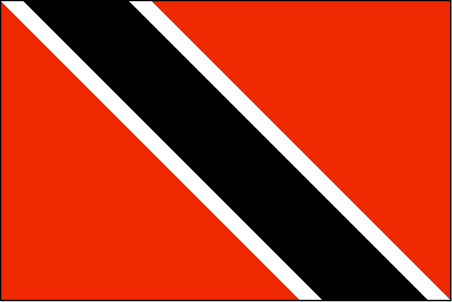 French planters, indenturered laborers, and their slaves emigrated to Trinidad during the French Revolution (1789) from Martinique, including a number of West Africans, and French creoles from Saint Vincent, Grenada, Saint Lucia and Dominica, establishing a local community before Trinidad and Tobago were taken from Spain by the British. Carnival had arrived with the French, indentured laborers and the slaves, who could not take part in Carnival, formed their own, parallel celebration called Canboulay.
Stick fighting and African percussion music were banned in 1880, in response to the Canboulay Riots. They were replaced by bamboo sticks beaten together, which were themselves banned in turn. In 1937 they reappeared, transformed as an orchestra of frying pans, dustbin lids and oil drums. These steelpans are now a major part of the Trinidadian music scene and are a popular section of the Canboulay music contests. In 1941, the United States Navy arrived on Trinidad, and the panmen, who were associated with lawlessness and violence, helped to popularize steel pan music among soldiers, which began its international popularization.it
Saint Vincent And The Grenadines Carnival History

THE SPIRIT:
Stemming from our African roots borrowed from European
tradition and mixed with our Caribbean and local folk lore Carnival in Saint
Vincent and the Grenadines has grown to be the nation’s premiere national
cultural festival.
More than the spirit of enjoyment Carnival or, “Vincy Mas”
as it is popularly called in this multi-island state epitomizes the celebration
of the talent, artistry and craft as displayed by our Panists, Calypsonians and
Masqueraders. The general populace
as a whole join in celebrating the success of our Cultural artisans.
MORE THAN A CULTURAL EVENT:
While we now speak of a Carnival culture ‘Vincy Mas’ is much
more than a cultural event. Carnival in Saint Vincent and the Grenadines has now become a major
economic activity in boosting the circulation of money during the largely dull
mid-year. Moreover, it now
attracts thousands of visitors annually to these shores including many overseas
based Vincentians who return to the homeland to enjoy themselves with family
and friends.
As a result, temporary employment is created and the
government earns revenue as a result of increased economic activity. Carnival has the potential to become a
major money spinner in Saint Vincent and the Grenadines.
MAJOR HIGHLIGHTS:
One of the innovations during the past twenty five (25)
years has been the MISS CARIVAL SHOW which over the past decade has become the
Caribbean’s premiere Beauty Pageant and still has the potential to grow in
Regional stature. The word CARIVAL
is a derivative from the words ‘Caribbean’ and ‘Carnival.’
Mardi Gras Parade of Bands which marks the culmination of
this grand festival is of course a major attraction. Masquerade Bands compete for the ‘Band of the Year’ title in a marvelous spirit of
keen rivalry. The Dimanche Gras
Show highlights the finals of the National Calypso Monarch Competition, King
and Queen of Carnival (featuring large and elaborate individual Masqueraders and
Costumes from the Mas bands) and Panorama, when steel bands attempt to outdo
each other in a musical crescendo.
Over the past seven (7) years, the Soca Monarch Competition
has attracted the largest of crowds to Carnival city, Victoria Park. Here Soca artistes are pitted against
one another as they use Stage craft and other antics fused with up tempo Soca
melodies to whip the crowd into a frenzy while they try for the top prize.
The children are not left out. For them there is the longest running and ever popular
Junior Carnival (Mas), Junior Calypso (Primary and Secondary Schools) Junior
Soca Monarch and Junior Panorama.
VISITORS:
As mentioned before our Carnival attracts droves of visitors
to these shores. They come from
other Caribbean countries, North America and the United Kingdom. An increase in visitors from European
countries is expected.
FROM FEBRUARY TO JULY:
In 1976, the then Carnival Development Committee (CDC) took
the decision to shift the dates of Carnival from February March to June /
July. The then Chairman of
CDC gave three major reasons for this decision:
- There would be greater financial returns since the effects of the Christmas spending would not be felt at mid-year.
- Our Carnival would not be overshadowed by that of Trinidad and Tobago which was more popular and well known both regionally and internationally and celebrated in February / March.
- There would be greater participation by Vincentians including those of the diaspora. It could be added that the idea for a change of Carnival from early to mid-year came from the makers of Carnival; the Calypsonians, Panists and Mas makers. Thus 25 June – 05 July 1977 marked the momentous change.
A Brief Footnote On Our Carnival Tradition
The colonization of Saint Vincent and the Grenadines by
France in the late eighteenth century brought with it a Prelenten Festival
called Carnival, which translated, literally means, “farewell to the flesh.”
The observance of Carnival continued under the rule of Great
Britain who supplanted France as colonizer. Until the abolition of slavery, Carnival was a celebration
of the ruling class and the privileged who, on the four days preceding Ash
Wednesday held their annual “Masked Balls” and dances.
With the coming of Freedom, the ex-slaves took Carnival to
the street and their descendants were to play the biggest role in the future
development of the festival. Of
African Origin, the freed people no doubt would have retained knowledge of
their roots with its festivals celebrating deities, arts and customs.
By 1872, the colonial authorities in pursuance of their
policy aimed at stamping out the “force and power” of the people culture
decided to ban the celebration. In
1879, Vincentians decided that ban or no ban, Carnival would be
celebrated. Naturally, the
colonial authorities brought out the armed might of the Empire to uphold the
ban. The people resisted and the Saint
Vincent Carnival riots of February 11, 1879 were written into the country’s
history.
Apart from the World War Years (1915-1918) and (1940-1945)
the peoples’ festival was an annual feature and continued to grow in
popularity. With the coming of
Adult suffrage in 1951 efforts were made by the peoples’ representatives to put
resources into the planning and organization of Carnival. In 1973, Carnival became the
responsibility of a Carnival Development Committee (CDC).
At a meeting of the CDC held on 19 November 1976 the
decision was taken to change the dates of the official celebration of
Carnival. This decision has proven
to be visionary and a resounding success. The components of Carnival, (Pan, Calypso and Mas) have played a dominant
role in the success of Vincy Mas’ as our Carnival has become known since the
momentous year, 1977. Today, our
Panists, Calypsonians and Mas makers continue to build on the rich traditions
established by their forebears. This year 2007, Vincentians, together with visitors will join in
celebrating the 30th Anniversary of Vincy Mas – Pearl
Anniversary.

Detailed information about cultural events can be found in a weekly newspaper called Today and in free brochures available from tourist centers.
Saint Lucia Carnival History
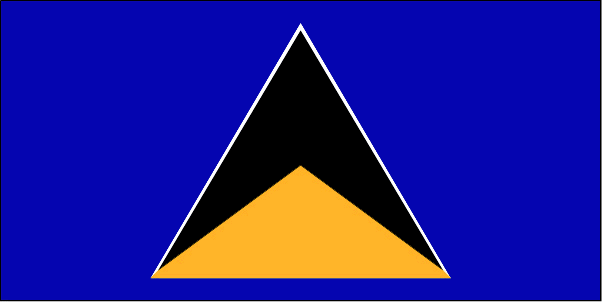
Carnival is a festival traditionally held in Roman Catholic and, to a lesser extent, Eastern Orthodox societies. Protestant areas usually do not have carnival celebrations or have modified traditions, such as the Danish Carnival or other Shrove Tuesday events. The Brazilian Carnaval is one of the best-known celebrations today, but many cities and regions worldwide celebrate with large, popular, and days-long events. These include the Carnevale of Venice and the Carnevale of Viareggio, Italy, the German Rhineland carnivals, centering on the Carnivals in Düsseldorf, Cologne and Mainz; the carnival of Santa Cruz de Tenerife, Canary Islands; in Andalusia(Spain)Carnival of Cádiz ; the carnaval of Torres Vedras, Portugal; Rio de Janeiro, Brazil; Rijeka, Croatia; Barranquilla, Colombia; the Carnaval and the Llamadas in Montevideo, Uruguay and Trinidad and Tobago Carnival. In the United States, the famous Mardi Gras celebrations in New Orleans, Louisiana, and Mobile, Alabama, date back to French and Spanish colonial times.
St. Lucia Carnival celebrations were shifted from the month of February before lent to July. St. Lucia Carnival activities usually start with the official launch of Carnival at the end of May or during the first week of June. Carnival stands out as one of the major festivals in St. Lucia. A highly traditional event, Carnival festivities usually includes competitions and performances by masquerade (Mas) bands, calypso and soca singers, steel bands, and beauty contestants.

The activities usually start with the Calypso competition which is a number of small concerts depicting social commentary in song. Participants compete as individuals in groups or “Tents” as they are referred to in St. Lucia. These Tents go through a number of performances until they vie for a place in the Finals of the St. Lucia Calypso Season.
Other events of St. Lucia Carnival include the Carnival Queen Pageant, The Soca Monarch Competition, and Parade of the Bands.
This Parade brings to a climax the celebration of St. Lucian Carnival. Titles such as Carnival Queen, Calypso Monarch, Panorama Champions, Party Monarch among others will have already been decided. On these days revellers take to the streets in a bouillion of colour and music as each band strives to capture the coveted title of “Band of the Year”.
Saint Kitts And Nevis Carnival History
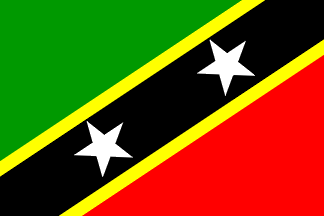
St. Kitts carnival begins on Christmas Eve and it is a ten-day affair. It is colourful, lively and goes into the New Year, and, is a part of the New Year's celebrations. The Carnival celebrations consist of a Calypso King and Queen competitions, various nights of youth talents and calypso contests, as well as beauty and talent pageantry.
The St. Kitts Music festival takes place towards the end of June and this is followed by the Nevis' "Culturama" celebration in July, which consists of costumed troupes, talent shows, beauty pageants, calypso competitions, arts and crafts and a local food-fir at the capital, Charlestown.
Other cultural interests for the Kittians and Nevisians are fishing tournaments, bicycle races, sailing regattas, music festivals and of course, cricket. People who are interested in shopping can find beautiful woodcarvings, neat paintings, coconut shell and seashell crafts and Sea Island cotton.
St. Kitts and Nevis are geographically located in an area that is considered the gateway to the Caribbean where ships sail. It was this area where many battles were fought as different Europeans tried to subjugate the natives of the Caribbean islands. The Carib Indians were fierce warriors and they were able to defend their lands. The Caribs called St. Kitts Liamuiga which when translated means "fertile land" which is a reference to the island's rich and productive volcanic soil.
Saint Barthélemy Carnival History
Carnival officially begins the Saturday that precedes Ash Wednesday, but in St. Barthelemy, the day after New Year's Day, people begin to unofficially start the celebrations. During this unofficial time, the carnival associations rehearse in the street; people spend their times making beautiful floats for the parades and getting themselves mentally, psychologically and physically prepared.
The official start of Fat Saturday (Samedi Gras) is the time that people go to parties to dance throughout the night.
King Vaval, a giant mannequin, is the king of Carnival and he is ostensibly featured along with the beautiful floats and revelers on Fat Sunday (Dimanche Gras). This is the time when all barriers of race, colour, or creed are broken down and people jump and dance to enjoy themselves to the fullest. This finishes late in the evening, and people return home to rest a few hours before partying the night away. There are parties every night during the official celebrations.
Fat Monday (Lundi Gras) is the day of the red devils. It is the day when everyone dresses in red. Today people continue to dress in red, which are decorated with shimmering reflective silver and glitter. These costumes are a thing of beauty as the costume designers seemingly let their imaginations flow to come up with beautiful works of art.
Ash Wednesday is the day when everyone dresses in black and white for the funeral of king Vaval to mark the end of the Carnival. Festivities go on throughout the day until seven o'clock in the evening. King Vaval is then burnt to mark the end of the Carnival season. Nevertheless, parties continue until midnight with great revelry. Some party people even continue partying until just before daybreak as they are some who say "dis party can't done 'til morning come."
Puerto Rico Carnival History
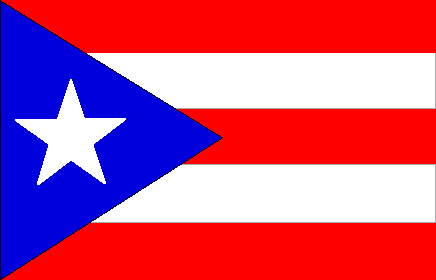
The first such events were held in Puerto Rico in the third decade of the 19th century. Their precedents were the masked balls or masked street festivals on San Pedro Day that were instituted under the government of Miguel de la Torre (1822-1837) to distract the population from the revolutions taking place in other Spanish colonies, called the Atlantic Revolution.
Traditionally, on the morning of the day the festival would begin, a group of musicians walked through the streets performing traditional folk music. This was called the alboradas. During the day, there was the parade of King Momo, along with the masked vejigantes, cabezudos and musical groups. There were also traditional student musical groups called estudiantinas that asked for donations to pay for their studies. The festival ended at sundown.
Throughout the activity, a festive multitude invaded the streets, dressed in disguises and parading through the streets dancing and singing songs and choruses. From the balconies, some of the participants threw food, water and objects at those below. They also tied pigs bladders, or vejigas, inflated with air, to a pole and attacked the passersby while repeating the refrain, "Vejigante a la boya, pan y cebolla!" or "¡Vejigante está pinta'o de verde, amarillo y colorao!" Thus arose the tradition known as the "vejigantes." Later, confetti and paper replaced the eggs, rotten fruit and dirty water that were thrown at the people below. In the Old San Juan carnaval, people walked from La Puntilla Arsenal to the Ballajá neighborhood. This festival was held, according to Medieval tradition, three days before the beginning of Lent.
Over the years, the festival came to be held as well in social clubs and casinos, where a carnaval queen was selected. In the first decade of the 20th century in San Juan, the Spanish Casino Carnaval and the Artesan Carnaval were held. The custom also took hold in Mayagüez, Ponce and Aguadilla. The elected queen would come out on Sunday to pass through the streets on her float, which was decorated in an allegorical theme, such as "One Thousand and One Nights," to the town plaza, where the public awaited her.
The tradition waned in the 1920s but was revived in the middle of the 1930s, as the government considered it useful for promoting tourism. Based on that premise, economic support was sought from businesses and industry to pay for the costs of running and organizing the festival. By the middle of the 20th century, calypso music from the Virgin Islands was introduced into the festival. The traditional bands were accompanied by a steel drum band. Later, the calypso music was replaced by traditional music that was accompanied by steel drums from the neighboring Caribbean islands. Eventually, the traditional instruments returned: the güiro, maracas, guitar, tiple and congas.
Today, some towns preserve the tradition of carnaval, although with variations. The "alboradas" and the "estudiantinas" no longer exist, but other components do.
References:
Canino, Marcelino. La Gran Enciclopedia de Puerto Rico, Tomo Folklore. Editor Vicente Báez, San Juan: Puerto Rico en la mano y La Gran Enciclopedia Inc, Primera edición, 1976. Impreso
Richard de Cancio, Haydée E. Ph.D. Los carnavales de ayer. En línea
De Hostos, Adolfo. Historia de San Juan ciudad murada. San Juan: Instituto de Literatura Puertorriqueña, 1969. Impreso
Abreu, Sara E. 300 años de la defensa de Arecibo por el capitán Correa Las fiestas carnavalinas en Puerto Rico: Un recuento de las fiestas del ayer. En línea
Nicaragua Carnival History

In the Nicaragua's capital city, Managua, it is only celebrated for 2 days. The Carnival in Managua is named "Alegria por la vida" translated to "Joy for Life" and features a different theme each year.
There's also a Festival In Managua which is called " Santo Domingo de Guzman" which lasts ten days.
Netherlands Carnival History
The rituals
Tradition has it that normal, everyday law gives way to the whims of a ‘humorous’ Carnival Committee, whose sole aim is to stop anyone from being serious during Carnival time. Local dignitaries are bizarrely caricatured in papier-mache figures and songs are sung poking fun, for example, at the local mayor.Many Dutch towns hold parades consisting of strange, grotesque, papier-mache figures on floats and people dressed up in outrageous outfits. Brass bands blast out oompah music as the normally staid citizens suddenly dance the conga together through the streets. Many, many litres of beer disappear down thirsty throats and TV and radio devote hours to popular Carnival songs whose lyrics are at best earthy, at worst obscene.
However, it is not true that all of the Netherlands descends into anarchy at Carnival. The main Carnival provinces are Limburg and the southern portion of North-Brabant, both near the Belgian border, with Maastricht usually regarded as top Carnival town. Though less numerous, Carnival towns in the north are no less enthusiastic and their numbers seem to grow each year. Even in towns which do not hold parades Carnival celebrations take place indoors in pubs and other venues.
Origins
Despite its current popularity, the origins of the modern Dutch festivities date from not long after the second World War. The origins of the global feast go back a lot further. It is said that Spring fertility celebrations with orgiastic elements have existed since prehistory. The Egyptians had days in the year when madness reigned over sanity and Romans partied to excess during Bacchanalia. Christians in mediaeval Holland adopted Carnaval as the last chance to eat, drink and be merry prior to the forty days fasting before Easter, when no meat was meant to pass the lips. They also gave it its modern name Carnival, connected with ‘carne’, or meat, unsurprisingly enough.During the Reformation in the seventeenth century, the provinces to the north of the great Maas and Rhine rivers became mainly Protestant while those to the south remained Roman Catholic. In the north, the sober Protestants soon did away with Carnival, which they saw as a ‘Roman Superstition’. Perversely, the wild, Catholic, mediaeval celebrations in the South also faded, perhaps due to influence from the North.
The modern Dutch Carnival dates mainly from after the second World War, when the southern provinces resurrected the tradition, organising the Carnival Committees who elected their own Prince Carnaval, the Head Jester. In the sixties, religious barriers began to crumble and the southern celebration of Carnival spread steadily to other provinces. Nowadays, the event is nationally recognised if not celebrated absolutely everywhere.
In Holland, the Carnival is far from over.
Montserrat Carnival History

The winning calypsonians is rewarded with prizes, celebrity status on the island, and they represent Montserrat as a cultural ambassador at the inter-island competitions. These party-loving people have these days well planned out with barbeques, competitions, sporting events, steel bands and dancing contests. It can be truly said that even though the island is small, the people can be deemed the best "party animals" that can be found.
Mexico Carnival History

In some of the central to northern regions the popular Norteña and Mexican rodeo influences are very present, whereas in the coastal or southern regions, Carnivals represent a more indigenous rendition. Each one will include many region-specific food dishes and drinks.
|
Cozumel's Carnival is thought to be the oldest in the Yucatan Peninsula and possibly in the whole of Mexico.
In 1876, La Revista de Merida magazine, first recorded the event. |
According to word-of-mouth, in 1896 costume competitions and ribbon dancing were organized during Carnival and a wooden bull called Huacax-xhé was made.
In 1904, for the first time, Don Manuel Vivas Martín, together with a baker from Campeche, introduced the Guaranducha to the Carnival. This traditional musical performance is thought to be from Cuba originally, but was made popular in Campeche.
|
In this musical play, the heros are played by blacks, and although all the parts are all female, all the actors are male.
Just before the 1920s, Félix González Bonastre arrived to the island from Tabasco and became involved in the event. |

Generations of fun.
|
He helped with the organization of student music groups, songs and social reviews for the Guaranducha.
From then on, the Guaranducha was enthusiastically supported by carnaveleros and finally, in the 1940s, women were also able to take part for the first time.
Like the island's economy, Cozumel's Carnival went through the doldrums in the early 1970s. It was rescued again by the Municipal Government in 1975, when the fiesta received a new impetus and regained popularity with locals.
Today, the tradition strengthens every year, as this safe, popular, family celebration continues to grow. The glamor and happiness that new generations have inherited help to ensure that Cozumel's Carnival will always be the best in the state.
Martinique Carnival history

The Antilles’ Carnival follows the universal
carnival tradition but has a distinctly European flavor.
In Martinique carnival festivities commence on the first Sunday after the Epiphany and reach their climax on Shrove Tuesday
In Martinique carnival festivities commence on the first Sunday after the Epiphany and reach their climax on Shrove Tuesday
In 2012 these 5 days of celebration are from
Saturday 18 to Wednesday 22 February.


The festivities start straight after the
Epiphany, that is to say even up to 2 months before Shrove Tuesday.
The weekends host street parades, themed events and private
celebrations that grow in intensity as the season progresses.
The local government and community representatives meet to organize the festivities, every Sunday sees processions throughout the island.
Every village elects a Queen and Junior Queen to be carried in triumph at the grand parade. Even the grandmothers compete for the honor, dressing in their finest traditional costumes.
The local government and community representatives meet to organize the festivities, every Sunday sees processions throughout the island.
Every village elects a Queen and Junior Queen to be carried in triumph at the grand parade. Even the grandmothers compete for the honor, dressing in their finest traditional costumes.


Hidden from prying eyes each village has
prepared new costumes and props which are unveiled only for the “vidé”
or Carnival Parade which occupies the streets of Fort de France for
the 5 days....


During the carnival the daily life of Martinique comes to a stand still and the island comes alive with “Carnival Fever”. Preparations start months in advance.
During the five days of official celebration
many of the younger generations don’t sleep, parading by day and
partying by night.
The Carnival King, or VAVAL (a satirical
mannequin representing a politician, a public figure or an
institution), is carried through the streets leading the festival
parade. The Carnival Queen , elected from the various villages, is
seated beside the Vaval during the parades.

Martinique’s most famous musical groups spread
out across the island between the parades ensuring the villages are
filled with music 24 hours a day and drawing the crowds along in
their wake.
The carnival is also an opportunity to show
off the traditional masks of the island:
The red clay men wear masks covered entirely in red clay, the nègs gwo-sirop, men coated from head to toe in sugar syrup and charcoal (are caricatures of the rebel slaves from Africa in contrast to the native Creole islanders); mariann lapofig, dressed entirely in banana leaves; the moko-zombis are dancers on African inspired trampolines; the guiablesses…mingling in glitzy costumes both the beautiful girls of the island as well as the young men cross-dressing in the abandon of the moment.
The red clay men wear masks covered entirely in red clay, the nègs gwo-sirop, men coated from head to toe in sugar syrup and charcoal (are caricatures of the rebel slaves from Africa in contrast to the native Creole islanders); mariann lapofig, dressed entirely in banana leaves; the moko-zombis are dancers on African inspired trampolines; the guiablesses…mingling in glitzy costumes both the beautiful girls of the island as well as the young men cross-dressing in the abandon of the moment.


During the Vidè the island throbs with pulsing music, tambourines, trumpets and horns are accompanied by steel drums, bamboo sticks even pots and pans become percussion instruments, the rhythms overlapping from Zouk to beguin.
There is even a street parade in pigiamas
that heads off at 5 am filling the streets of Lamentin with the
shuffling of “slippered” feet.
The pinnacle of the festivities is during the
four days leading up to Ash Wednesday.
Every day has its theme, Saturday and Sunday
everyone dresses up as they please, Monday is the day of Burlesque
Weddings, men dressed as brides parading on foot, float and brad jak....


Tuesday is the day of the devil: everyone
dressed in red and costumed as the devil. Finally on Ash Wednesday,
the day dedicated to the joyeuses pleureuses (devilettes,
devils that cry for the death of Vaval), all dressed in black and
white of mourning for the death of Vaval, who is symbolically burnt
on a bonfire at nightfall.
At the celebration’s end the island enters the
period of Lent, that leads up to Easter.
Lent, the period of fasting and abstinence coincides with the dry season on Martinique. Tradition requires that one does not dance, listen to music and all weddings and other celebrations are postponed until after Lent.
Lent, the period of fasting and abstinence coincides with the dry season on Martinique. Tradition requires that one does not dance, listen to music and all weddings and other celebrations are postponed until after Lent.
 |
 |
 |
 |
 |
A bit of
history…..
The carnival
was first celebrated in Martinique at Saint Pierre by the
French Catholics in the 18° century. In the 17° and 18°
century it was a celebration reserved for the rich colonies,
with elegant receptions in costume.
Only after the abolition of Slavery in 1848 the carnival was democratized and adopted its characteristic style, influenced by the former slaves’ adaptation of their own beliefs and traditional instruments: tambourines, cha-cha, ti-bois…
Only after the abolition of Slavery in 1848 the carnival was democratized and adopted its characteristic style, influenced by the former slaves’ adaptation of their own beliefs and traditional instruments: tambourines, cha-cha, ti-bois…

From 1848 to 1902 the Carnival of Saint Pierre was particularly renowned in Martinique, despite the fact that the celebrations at the time were overshadowed by the discrimination of the time . In effect, one side of the colony was celebrating with masked balls, private banquettes and luxurious costumes whilst the other side of the island was occupied with celebrations of the vidés nègres. After the catastrophe of Saint Pierre, the carnival festivities were halted for 2 years in Martinique.
It was upon recommencement that the Carnival relocated its hub to Fort de France
Jamaica Carnival History
JAMAICA FESTIVAL
a national salute to local talent and ingenuity in local vernacular
"a bam
bam." How appropriate that the phrase introduced to the nation in 1966
by Toots and the Maytals in their winning festival song, can be used to
aptly describe Jamaica Festival itself. A major training opportunity for
thousands of Jamaicans, Jamaica Festival's mandate was (and still is)
to focus attention on "Things Jamaican" Jamaican creativity and
cultural awareness across socio-economic levels. As Edward Seaga, then
JLP Minister of Development and Welfare, spelled out in his Long-term
Development Plan for Jamaica (1963-8), festival was integral to national
development because it was a way of giving Jamaicans a sense of who we
are, and what our history and culture is all about. These concerns took
on added importance during that immediate post-Independence period.
 Seaga remembers the
1962 Independence Festival celebrations which he helped coordinate and
which laid the groundwork for the real start of festival as we know it
today, as being aimed at commemorating a substantial achievement with
the excitement and enthusiasm it deserved. Unlike other countries where
the sheer achievement of independence was itself an occasion for joyous
celebration, marked by a specific day, Jamaica's independence was achieved
gradually and a convenient day near to Emancipation Day was chosen (the
first Monday in August) to mark Independence. There was therefore a need
he said, for "something to mobilize the spirit of the people". That something
became Jamaica Festival, the first of which was really held in 1963, on
the anniversary of the previous year's Independence celebrations. Festival
has since been staged every succeeding year without fail. Although popular
support for it has varied at times over the past 4 decades, it has nevertheless
become part of the formal Jamaican development landscape a visible
and tangible expression of the vitality and range of Jamaican culture
and creativity. Seaga remembers the
1962 Independence Festival celebrations which he helped coordinate and
which laid the groundwork for the real start of festival as we know it
today, as being aimed at commemorating a substantial achievement with
the excitement and enthusiasm it deserved. Unlike other countries where
the sheer achievement of independence was itself an occasion for joyous
celebration, marked by a specific day, Jamaica's independence was achieved
gradually and a convenient day near to Emancipation Day was chosen (the
first Monday in August) to mark Independence. There was therefore a need
he said, for "something to mobilize the spirit of the people". That something
became Jamaica Festival, the first of which was really held in 1963, on
the anniversary of the previous year's Independence celebrations. Festival
has since been staged every succeeding year without fail. Although popular
support for it has varied at times over the past 4 decades, it has nevertheless
become part of the formal Jamaican development landscape a visible
and tangible expression of the vitality and range of Jamaican culture
and creativity.
In a 1968 presentation to the House, Seaga sought to institutionalise and formalise festival proceedings by proposing to establish the Jamaica Festival Commission. The Act was passed unanimously. In 1980 another Bill was passed in Parliament making The Festival Commission the Jamaica Cultural Development Commission (JCDC), the name by which it is known today, and a name well suited to its work which by then had become entwined with cultural development. Today, the JCDC is also responsible for organizing aspects of the country's annual independence celebrations. |
||
|
THE ROOTS OF FESTIVAL Jamaica has a long track record of creative arts competitions. One of the first known was staged by the Institute of Jamaica in 1897 to commemorate Queen Victoria's 60th year on the throne. Competitions were held annually in vocal and instrumental music, handicraft, poetry, architecture, essay writing and natural history research until 1907 when the earthquake intervened. In the early part of the 20th century, all-island elocution contests and music festivals coupled with the tradition of eisteddfod (i.e., local gatherings of music competitions) organised by Mico, the Jesuits at St. George's College, the Music Society of Jamaica and the Poetry League became popular. The year 1910 is worth special note as it marked the introduction of a young Jamaican named Marcus Garvey who represented his parish of St. Ann in elocution, placing third overall. In general these contests were judged by Englishmen and contained a decidedly English aesthetic. In the 1930s, a decade of significant social upheaval and change on the island, Jamaica Welfare Ltd. was established and village competitions that included art, craft, plays, preserves and traditional dance, began. In addition, Mico graduates, exposed to music and art forms, took that influence with them as they began their teaching assignments around the island, contributing to the growth of a national art form. Yet, in spite of claims to be representative of the entire island, these contests remained largely Kingston-based until the 1946 Portland Festival. This week-long event, a spontaneous effort organized by local citizens that included bringing schools and adults together to allow for eliminations at the inter-school and inter-village levels, marked the beginning of a movement. St. Catherine followed suit in 1949, St. Ann in 1951 and Manchester in 1954. In 1955, the movement evolved to include celebrations that were not only islandwide but year-long. For the first time parish level competitions led up to national competitions with national finals held in Kingston. The popular three-hour long Jamaica Bandwagon with its float parade organised by Eric Coverly was introduced. Co-ordinated by arts stalwart Robert Verity and presented in all parish capitals, the bandwagon took popular entertainment to the people at street corners and in the villages. Bennett helped organise arts celebrations in 1960 and 1962 as part of the Independence Festival, and went on to be awarded the Order of Distinction in 1977 for his outstanding contributions in the field of Jamaican theatre. By the early 1960s, however, no central organisational structure to ensure the repetition, growth and increasing Jamaicanisation of such events was yet in place. That development came in 1963, when following the success of the Independence Festival, such an overall organisation was introduced. A small unit known as the Festival Office was established in the Ministry of Development and Welfare under Seaga's leadership, and in 1964, Hugh Nash, a man whose name would become synonymous with Jamaica Festival over the years, was appointed director. Nash held that post from 1964-67, in 1969, from 1974-77 and 1981-83. In 1983 he, too, was awarded the Order of Dis-tinction for his contributions to the development of festival. When asked to reflect on the development of festival, Nash vividly recalls the enthusiasm of the thousands of volunteers and the non-partisan nature of their involvement. Each parish was divided into Festival Zones with a committee for each zone charged with encouraging entries in dance, music, speech and the culinary arts. (It wasn't until 1966 that the popular festival song competition was added). An important administrative strategy that began in the early years was the annual national evaluation seminar that took place in September each year to highlight what worked and what needed improvement. Nash recalls these sessions as full of creative energy, with cultural activists like Rex Nettleford and Dr. Joyce Robinson and himself sitting for hours with Mr. Seaga (sometimes on the floor surrounded by papers), throwing out idea after idea. Nash explained that the timing of festival during the summer linked it naturally to efforts to stimulate travel to the island amongst non-Jamaicans and Jamaicans living abroad. It also nicely coincided with the annual Denbigh Agricultural Show which festival performers and queens often attended to add a cultural element to the proceedings. When asked to reflect on the development of festival, Seaga feels that festival has in many ways lived up to his dream of "maintaining, preserving and developing our cultural resources, the unique natural, creative talents which belong to our people, having opened the doors for young people around the country in all fields of creativity and given them a means of expression." |
||
|
FESTIVAL TODAY
Today, the JCDC falls under the auspices of the Ministry of Local Government and Community Development. The administrative structure still maintains a large volunteer-base particularly at the parish level where a JCDC officer is appointed to oversee activities. Total JCDC staff numbers over 100 and includes National Youth Service (NYS) members and holiday workers. Current programmes reap the benefit of the early Festival movement's attempt to establish a comprehensive presentation of all the arts imaginable, from the graphic to the culinary, to the performance and the literary. As a result, they can now be called traditional festival events. These include Art and Photography, Craft, Literary Arts, the National Mento Band competition, Dances, Speech (in standard and Jamaican English), Drama, Music, the National Festival Song and Gospel Song competitions as well as the Miss Jamaica Festival Queen Contest. The best of the Festival of the Performing Arts (dance, speech, drama and music) is showcased in the JCDC's annual Mello Go Roun' which this year will be staged in Montego Bay in addition to Kingston. The JCDC also presents an annual exposition of art, craft, traditional music, dance, games and food at the National Mento Yard. Current Executive Director, Marcia Hextall, the fifth female to hold that post, is excited at the activities planned for this special 40th year, particularly the float parade an event that last took place in the 1980s. The parade of 19 floats, 10 costume groups and 12 effigies will begin at Devon House on Independence Day and end up at the National Stadium. Also new this year is the 'Festival Train' a road show set to travel across the island from Sunday, July 28 to Friday, August 2 stopping at 30 locations, featuring the finalists in many of the competitions. Parishes will have at least one matinee and one night event. Another key event is the 'Oldies Festival Song Showcase' to be held in Morant Bay and Montego Bay featuring the songs from the first 10 years Toots and the Maytals will headline. Additional highlights of this year's independence celebrations include the 'Grand Send-off' on Sunday, July 28 in Morant Bay and the final "Ol' Time Independence Street Dance" in Half-Way Tree on Wednesday, July 31. Forty years later, what has now become a traditional report to the nation continues. |

Honduras Carnival History

[edit] The Carnival Today
Today the festivities start with the crowning of the queen, 2 weeks before the parade. After, on May 14 a small procession with many of the local high schools takes place. The official St. Isidore feast day is on May 15 and it’s a local holiday.The week before the parade, from Monday to Friday, many neighborhoods and plazas have their carnavalito. The amount of carnavalitos varies. The neighborhoods and Plazas that have or still participate with their own small carnival are:
- Barrio La Isla
- Barrio Ingles
- Barrio Mejia
- Barrio El Iman
- Colonia El Sauce
- Barrio Solares Nuevos
- Mall Mega Plaza
- Plaza Premiere
Haiti Carnival History
Since it marks the beginning of the season for profound repentance and abstinence, it inadvertently concludes the period of total indulgence and pleasure seeking, a saturation of the senses that only the devilish side of a Christian can understand. I suppose if one is to repent, one must have something to repent for.
Let's get down to it. This is about the biggest party ever; globally let's all say: "C-A-R-N-I-V-A-L".
All the angels on earth are singing and dancing to the overwhelming rhythms in blinding lights and colors. It's time for Mardi-Gras! And you thought it was about Christmas!
Modern carnival celebrations developed in Europe during the Middle Ages (5th century to the 15th century) as a part of the Roman Catholic Church tradition named Lupercalia: a fertility festival held each February in ancient Rome.
The word carnival derives from the Latin word Carnavale that means Meat Farewell. The carnival period, which concluded on Mardi-Gras (Fat-Tuesday), pertains to the custom of consuming all the fats in the home before the Easter season. It is important to note that Wednesday following Mardi-Gras, known as Ash Wednesday, marks the first day of the penitential season of lent in Christian churches. It is customary for Roman Catholics to abstain from eating meat during the 40 days of Lent leading to Good Friday, and Easter Sunday. Simply said, the season of carnival leading to Mardi-Gras is the last opportunity for revelry and indulgence in food, drink, music, and whatever before the temperance of Lent.
The Tuesday of Mardi -Gras varies from year to year. However, it always falls between February 3rd and March 9th. The duration of the carnival period also varies according to national and local traditions. For example, in Germany where this celebration is called Fasching, it begins at the 11th hour of the 11th day of the 11th month. In the carnival capital of the world, Rio de Janeiro, the actual carnival parades begin five days before Fat Tuesday. In New Orleans they begin twelve days before Mardi-Gras. In Haiti, it is the custom for radio stations to begin broadcasting the carnival musical themes known as "Meringue Carnavalesque" as soon as the New Year's festivities are over.
The carnival festival is marked by spectacular parades featuring floats, pageants/reines, masked balls, elaborate costumes, seductive music, and dancing in the streets. The pre-lenten carnival is celebrated predominantly in the Roman Catholic communities in Europe and in the Americas. The more famous cities countries include France, Germany, Rio de Janeiro, New Orleans, Trinidad, and Haiti. These festivities bring a great deal of diversity to the culture of these countries, not to mention economic growth. In New Orleans, for example, the carnival parades generate approximately one billion dollars in revenue.
One of the most important elements of carnival is music. Its purpose is to accentuate the hopes and dreams of the people. For Haitians, there is a long history of romance between the people and the inspired sounds of the sun. Our musicians make it their duty to speak our sores, loves, spirit, and laughter.


During slavery, the slave masters "Les Colons" continued to celebrate carnival according to their tradition in Haiti. The slaves could not celebrate like Les Colons because they were not free. However, they used different strategies to elude Les Colons later on. After the independence in 1804, the newly freed individuals took advantage of their freedom to celebrate carnival for the first time. They had all kings of Indian and Africans clothing, food, music, and cultural shows during the celebration. They continued to celebrate the event until the modern age of our society.
In the 1950's and 60's Haitians' carnival took a different turn, but kept all of the flavors of the past. The Sundays preceding "Les trois jours Gras" one meets all types of "Mardi Gras" from 9:00 AM to about midnight all over the country. Poor, rich, middle class, educated or not wore carnival costumes and visited one neighborhood to another. It was an all day event beginning Friday to Fat Tuesday. On Friday, the Universities organized their own carnival known as "Carnaval Des Etudiants." They traveled the streets of the capital and the provinces, with their floats, their musical bands, and their pageants. Saturday was reserved for all grammar and high school students. As observers, the adults enjoyed themselves with the youth during these two days. The other three days were the period during which people across the nation looked forward to. The floats for the carnival was arranged as follows:
1) Decorated bicycles
2) Decorated motorcycles
3) Guard-cote, special Mardi-Gras, machan feuille/leaves merchants
4) Magicians, priests, lawyers, baron, funeral march,�
5) Decorated mask, Indians, Zombies, and Africans
6) Chaloskas, chouchoune, decorated animals such as horses, donkeys
7)"Band a pied" such as; Ti Tato, Maison Ante, Zobolo, YoYo, Dragon, Diabolo, Lobodia, Derange, Aroyo, Peuple S'amuse, Minuit-Minuit, Grande Puissance, Tolalito, and Autofonic.
No one was allowed in the celebration without a uniform. Each band or band a pied had a different color of uniform. The uniform determined which band the fans belonged to. For the first time, in 1967, Webert Sicot participated with his band in the carnival. One year later in 1968, he introduced Ti Simone, a pageant, to his float. Also in 1969, Nemours participated for the first time in the carnival with his band. Then in 1969 and thereafter, we found mini bands like Les Gypsies, Les Difficiles, Suga Combo, Sheu-Shleu, Les Ambassadeurs, and later one found Bossa Combo, Scorpio and DP Express.
Subscribe to:
Posts (Atom)