
Sunday, 15 April 2012
Venezuela Carnival History

U.S Virgin Islands Carnival History

In the mid-1600s and 1700s Europeans from countries such as Spain, Portugal, France, England and Denmark colonized the islands of the Caribbean. They brought with them the celebrations and festivals that were familiar and naturally tried to replicate the familiar in the New World. European celebrations included religious holidays and came in a variety of forms such as dress balls, parties, house to house visits and street processions. European nations sought the islands for developing plantations and the primary source of labor was enslaved Africans from West and Central Africa. They too brought with them the celebrations and festival traditions that were familiar and tried, often with difficulty, to replicate them. Their festivals were organized around certain deities or spirits, to mark a transition in life or in the community and in recognition of changes in seasons whether related to climate or to agricultural production. They incorporated a variety of forms, quite often including singing or chanting, drumming, masking and a form of street theater with performer and audience participation.
Africans brought to the Caribbean the knowledge of how to make the items they used in festivals like drums and masks, and their uses. With this they could reproduce such items. In the U.S. Virgin Islands (formerly the Danish West Indies) for example, Africans made drums using just a skin stretched over a calabash or a small barrel. An empty pot also did the job. Traditional African drumming and dances however were often feared by Europeans. They thought these might be used to communicate secretly and to plan uprisings. Drumming was often banned and other laws tried to deny Africans of their cultural identity. They were often expected to abandon their own traditions and adopt at least part of the European culture.
Indeed enslaved Africans in the Caribbean were exposed to European celebrations and festival traditions, but they generally were not allowed to participate directly. European planters and their associates celebrated amongst themselves. In some cases missionaries were responsible for introducing religious holidays and related traditions to the enslaved Africans. In the face of being introduced to new traditions and having bans on old traditions, enslaved Africans persevered. They came from different parts of Africa and therefore had different traditions, but they extracted and reinvented things from collective memories. They were able to maintain some of these traditions by fitting them into accepted European festival and holiday framework. During holidays, like Christmas and New Years, enslaved people would usually have time off and an opportunity to celebrate. These times of celebration created momentum for the cultural fusion of the two groups’ traditions and for the development of new ones. African traditions were also maintained through concessions of plantation owners and in secret.
 A
great example of the cultural fusion that took place is to look at two
popular dances considered to be U.S. Virgin Islands folk dances. The
(European) quadrille is a popular old-time dance. It is maintained today
through dance groups. It is said that plantation owners would
occasionally call on members of the enslaved African community, the ones
known to be good musicians, to entertain at parties. Perhaps in this
way the dance passed along. Another dance once popular and still
preserved in the U.S. Virgin Islands is the (African) bamboula. As
previously noted African dances and the drumming that went with them
were feared and often banned. Historical accounts from the late 1700’s
however indicate that talented dancers from amongst the enslaved people
were sometimes brought to the plantation house to perform. This shows
that the African dance tradition was being maintained, likely in secret
and eventually, at least on some plantations, it was accepted.
A
great example of the cultural fusion that took place is to look at two
popular dances considered to be U.S. Virgin Islands folk dances. The
(European) quadrille is a popular old-time dance. It is maintained today
through dance groups. It is said that plantation owners would
occasionally call on members of the enslaved African community, the ones
known to be good musicians, to entertain at parties. Perhaps in this
way the dance passed along. Another dance once popular and still
preserved in the U.S. Virgin Islands is the (African) bamboula. As
previously noted African dances and the drumming that went with them
were feared and often banned. Historical accounts from the late 1700’s
however indicate that talented dancers from amongst the enslaved people
were sometimes brought to the plantation house to perform. This shows
that the African dance tradition was being maintained, likely in secret
and eventually, at least on some plantations, it was accepted.
Music and dance were integral parts of celebrations during the plantation era in the Caribbean. These traditions continued to evolve over time; as did the various periods of celebration. Though most celebrations occurred around Christmas and the pre-lent festival of Carnival some were planned around the agricultural cycle, the end of the sugar cane harvest for example. It is from these various festivals with their creolized music, dance and masquerading traditions that Carnival developed.
Today Carnival is celebrated across the Caribbean. On some islands the festival has endured almost annually since the 1800s. On other islands the 1900s saw various festival traditions being revived into Carnival, often incorporating elements from neighboring islands. Carnival is however much more than a modern festival with remnants of contributing traditions, both European and African. While retaining similarities it has evolved into something that is also different – enough so to be considered uniquely Caribbean.
Carnival in the U.S. Virgin Islands
 St. Thomas:
The first Carnival in St. Thomas was on February 14, 1912 and the
second in 1914 – both while the islands were part of the Danish West
Indies. The early Carnival celebrations included activities that are
part of current Carnivals like bands, Carnival queen, special games and a
parade. After 1914 it would be 38 years before there was another
Carnival on St. Thomas. During this time music, masquerading and dancing
continued on special days, holidays and other events. Some of these
traditions began to lose some ground as they competed with new trends
brought to the island by immigration and travel. In 1952 a radio
personality named Ron De Lugo was reminiscing about festival traditions.
De Lugo sent out a call that there should be a Carnival. Some people in
the community did not think it was a good idea, the population was very
aware of class distinctions and there wasn’t much social life between
them. De Lugo many years later in an interview noted that on Carnival
parade day he feared that no one would show up. But people did show up,
and Carnival has been going annually ever since. Over the years
additional elements have been added. It is currently a three week event
taking place in April and is called V.I. Carnival.
St. Thomas:
The first Carnival in St. Thomas was on February 14, 1912 and the
second in 1914 – both while the islands were part of the Danish West
Indies. The early Carnival celebrations included activities that are
part of current Carnivals like bands, Carnival queen, special games and a
parade. After 1914 it would be 38 years before there was another
Carnival on St. Thomas. During this time music, masquerading and dancing
continued on special days, holidays and other events. Some of these
traditions began to lose some ground as they competed with new trends
brought to the island by immigration and travel. In 1952 a radio
personality named Ron De Lugo was reminiscing about festival traditions.
De Lugo sent out a call that there should be a Carnival. Some people in
the community did not think it was a good idea, the population was very
aware of class distinctions and there wasn’t much social life between
them. De Lugo many years later in an interview noted that on Carnival
parade day he feared that no one would show up. But people did show up,
and Carnival has been going annually ever since. Over the years
additional elements have been added. It is currently a three week event
taking place in April and is called V.I. Carnival.
 St. Croix:
St. Croix’s Carnival is called the Crucian Christmas Festival and it
became an annual event in 1952 with the revival of old holiday
traditions transformed into modern Carnival. Dating back at least to the
early-1800s enslaved Africans on St. Croix were allowed to celebrate
Christmas and New Years. The celebrations on plantations included
drumming, singing and dancing. In the main towns it involved parading
through the streets of town singing, dancing and playing drums; often
stopping door to door for rum and wine. Masquerading was popular during
Christmas and other holidays including Easter and Whit Monday. These
traditions continued into the early 1900s but saw some decline. Social
events kept music traditions and dances like the quadrille, lancers and
bomboula alive. The Carnival festival collected traditions into one big
event with a focus on the former holiday celebrations. The event has
become more and more organized each year and has incorporated additional
events. Today it last about four weeks starting in December and ending
with the parades in January.
St. Croix:
St. Croix’s Carnival is called the Crucian Christmas Festival and it
became an annual event in 1952 with the revival of old holiday
traditions transformed into modern Carnival. Dating back at least to the
early-1800s enslaved Africans on St. Croix were allowed to celebrate
Christmas and New Years. The celebrations on plantations included
drumming, singing and dancing. In the main towns it involved parading
through the streets of town singing, dancing and playing drums; often
stopping door to door for rum and wine. Masquerading was popular during
Christmas and other holidays including Easter and Whit Monday. These
traditions continued into the early 1900s but saw some decline. Social
events kept music traditions and dances like the quadrille, lancers and
bomboula alive. The Carnival festival collected traditions into one big
event with a focus on the former holiday celebrations. The event has
become more and more organized each year and has incorporated additional
events. Today it last about four weeks starting in December and ending
with the parades in January.
St. John: The Carnival celebrations on St. John have triple celebration power. It is Carnival and it takes place during two important holidays; Emancipation Day - a local holiday commemorating the abolition of slavery and 4th of July/Independence Day - the U.S. holiday commemorating independence. In 1960 the 4th of July celebrations on St. John evolved into Carnival and the festival lasted more than a week. Today the event last several weeks and culminates on the 4th of July. It is called the St. John Festival.
Turks And Caicos Islands Carnival History
 Junkanoo is believed to have begun during the 16th and 17th
century. The slaves were given a special holiday at Christmas time in
which they could be with their families to celebrate the holidays with
African dance, music and costumes. This continued after emancipation and today Junkanoo has moved from a simple festival to a formal organized festival with sophisticated costumes, music and different
themes every year. This festival has reached such a great height that
they are people are comparing it to Carnival in the Carnival world's
capital, Rio de Janeiro and New Orleans in Louisiana.
Junkanoo is believed to have begun during the 16th and 17th
century. The slaves were given a special holiday at Christmas time in
which they could be with their families to celebrate the holidays with
African dance, music and costumes. This continued after emancipation and today Junkanoo has moved from a simple festival to a formal organized festival with sophisticated costumes, music and different
themes every year. This festival has reached such a great height that
they are people are comparing it to Carnival in the Carnival world's
capital, Rio de Janeiro and New Orleans in Louisiana.
Junkanoo is the greatest celebration that takes place in the Turks and Caicos Islands with street parades of masqueraders wearing colourful costumes, goatskin drums, jangling cowbells and other rhythm instruments. This festival starts in the early hours of Boxing Day, December 26th, and in the early hours of January 1st when revelers are coming back from the New Year's Eve partie
Sint Maarten Carnival History

Take loud drum and calypso beats, glittering and feathered costumes, mouthwatering food, lots of drinks and thousands of happy people, blend them all together and enjoy the most cultural festivity on St Martin/St Maarten: the Caribbean Carnival.
The island's wildest celebration, held on both sides but on different dates. The French carnival fever takes hold during Lent where 'jump-ups' and huge parades color the streets of Marigot and Grand-Case. Zouk and reggae fills every corner with performances from popular local and international bands. A larger celebration is held in April on the Dutch side where the island comes to a standstill for over 17 days and nights. For months locals put their souls into sewing Carnival costumes and writing songs ready for the big celebrations. Some of the most beautiful creations of previous carnival seasons are at display inside the Jump Up Casino in Philipsburg. Go there to get a true taste of Sint Maarten Carnival, even if you missed the original celebration.
Each Carnival inspires a fresh and marvelous batch of calypso, often satirical and politically charged. The Calypsonians will compete for the title of Calypso King or Queen, a contest that draws hundreds of musicians and dancers from all the neighboring islands. If the partygoers are not hitting the street they are most likely to be jammin' in Carnival Village which sits on the edge of Philipsburg and is constructed just for the carnival. More than a hundred booths are there to serve you food, from traditional 'Johnny cakes' and 'fungi' to Indian curry and 'roti', enough to make your taste buds go wild. If you think you've seen dirty dancing, wait till you experience the 'bumping and grinding' of the locals. The rhythm is so pervasive there's no escaping the beat, you won't even want to. So come and seek the heart of St. Martin's Carnival extravaganza and leave with memories that will make you smile.
Trinidad And Tobago Carnival History
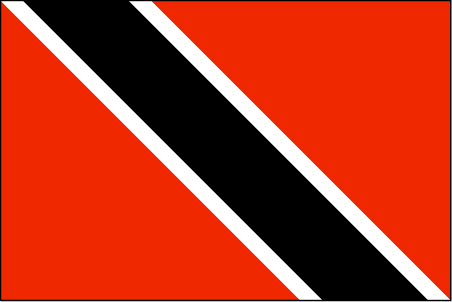 French planters, indenturered laborers, and their slaves emigrated to Trinidad during the French Revolution (1789) from Martinique, including a number of West Africans, and French creoles from Saint Vincent, Grenada, Saint Lucia and Dominica, establishing a local community before Trinidad and Tobago were taken from Spain by the British. Carnival had arrived with the French, indentured laborers and the slaves, who could not take part in Carnival, formed their own, parallel celebration called Canboulay.
Stick fighting and African percussion music were banned in 1880, in response to the Canboulay Riots. They were replaced by bamboo sticks beaten together, which were themselves banned in turn. In 1937 they reappeared, transformed as an orchestra of frying pans, dustbin lids and oil drums. These steelpans are now a major part of the Trinidadian music scene and are a popular section of the Canboulay music contests. In 1941, the United States Navy arrived on Trinidad, and the panmen, who were associated with lawlessness and violence, helped to popularize steel pan music among soldiers, which began its international popularization.it
Saint Vincent And The Grenadines Carnival History

THE SPIRIT:
Stemming from our African roots borrowed from European
tradition and mixed with our Caribbean and local folk lore Carnival in Saint
Vincent and the Grenadines has grown to be the nation’s premiere national
cultural festival.
More than the spirit of enjoyment Carnival or, “Vincy Mas”
as it is popularly called in this multi-island state epitomizes the celebration
of the talent, artistry and craft as displayed by our Panists, Calypsonians and
Masqueraders. The general populace
as a whole join in celebrating the success of our Cultural artisans.
MORE THAN A CULTURAL EVENT:
While we now speak of a Carnival culture ‘Vincy Mas’ is much
more than a cultural event. Carnival in Saint Vincent and the Grenadines has now become a major
economic activity in boosting the circulation of money during the largely dull
mid-year. Moreover, it now
attracts thousands of visitors annually to these shores including many overseas
based Vincentians who return to the homeland to enjoy themselves with family
and friends.
As a result, temporary employment is created and the
government earns revenue as a result of increased economic activity. Carnival has the potential to become a
major money spinner in Saint Vincent and the Grenadines.
MAJOR HIGHLIGHTS:
One of the innovations during the past twenty five (25)
years has been the MISS CARIVAL SHOW which over the past decade has become the
Caribbean’s premiere Beauty Pageant and still has the potential to grow in
Regional stature. The word CARIVAL
is a derivative from the words ‘Caribbean’ and ‘Carnival.’
Mardi Gras Parade of Bands which marks the culmination of
this grand festival is of course a major attraction. Masquerade Bands compete for the ‘Band of the Year’ title in a marvelous spirit of
keen rivalry. The Dimanche Gras
Show highlights the finals of the National Calypso Monarch Competition, King
and Queen of Carnival (featuring large and elaborate individual Masqueraders and
Costumes from the Mas bands) and Panorama, when steel bands attempt to outdo
each other in a musical crescendo.
Over the past seven (7) years, the Soca Monarch Competition
has attracted the largest of crowds to Carnival city, Victoria Park. Here Soca artistes are pitted against
one another as they use Stage craft and other antics fused with up tempo Soca
melodies to whip the crowd into a frenzy while they try for the top prize.
The children are not left out. For them there is the longest running and ever popular
Junior Carnival (Mas), Junior Calypso (Primary and Secondary Schools) Junior
Soca Monarch and Junior Panorama.
VISITORS:
As mentioned before our Carnival attracts droves of visitors
to these shores. They come from
other Caribbean countries, North America and the United Kingdom. An increase in visitors from European
countries is expected.
FROM FEBRUARY TO JULY:
In 1976, the then Carnival Development Committee (CDC) took
the decision to shift the dates of Carnival from February March to June /
July. The then Chairman of
CDC gave three major reasons for this decision:
- There would be greater financial returns since the effects of the Christmas spending would not be felt at mid-year.
- Our Carnival would not be overshadowed by that of Trinidad and Tobago which was more popular and well known both regionally and internationally and celebrated in February / March.
- There would be greater participation by Vincentians including those of the diaspora. It could be added that the idea for a change of Carnival from early to mid-year came from the makers of Carnival; the Calypsonians, Panists and Mas makers. Thus 25 June – 05 July 1977 marked the momentous change.
A Brief Footnote On Our Carnival Tradition
The colonization of Saint Vincent and the Grenadines by
France in the late eighteenth century brought with it a Prelenten Festival
called Carnival, which translated, literally means, “farewell to the flesh.”
The observance of Carnival continued under the rule of Great
Britain who supplanted France as colonizer. Until the abolition of slavery, Carnival was a celebration
of the ruling class and the privileged who, on the four days preceding Ash
Wednesday held their annual “Masked Balls” and dances.
With the coming of Freedom, the ex-slaves took Carnival to
the street and their descendants were to play the biggest role in the future
development of the festival. Of
African Origin, the freed people no doubt would have retained knowledge of
their roots with its festivals celebrating deities, arts and customs.
By 1872, the colonial authorities in pursuance of their
policy aimed at stamping out the “force and power” of the people culture
decided to ban the celebration. In
1879, Vincentians decided that ban or no ban, Carnival would be
celebrated. Naturally, the
colonial authorities brought out the armed might of the Empire to uphold the
ban. The people resisted and the Saint
Vincent Carnival riots of February 11, 1879 were written into the country’s
history.
Apart from the World War Years (1915-1918) and (1940-1945)
the peoples’ festival was an annual feature and continued to grow in
popularity. With the coming of
Adult suffrage in 1951 efforts were made by the peoples’ representatives to put
resources into the planning and organization of Carnival. In 1973, Carnival became the
responsibility of a Carnival Development Committee (CDC).
At a meeting of the CDC held on 19 November 1976 the
decision was taken to change the dates of the official celebration of
Carnival. This decision has proven
to be visionary and a resounding success. The components of Carnival, (Pan, Calypso and Mas) have played a dominant
role in the success of Vincy Mas’ as our Carnival has become known since the
momentous year, 1977. Today, our
Panists, Calypsonians and Mas makers continue to build on the rich traditions
established by their forebears. This year 2007, Vincentians, together with visitors will join in
celebrating the 30th Anniversary of Vincy Mas – Pearl
Anniversary.

Detailed information about cultural events can be found in a weekly newspaper called Today and in free brochures available from tourist centers.
Subscribe to:
Posts (Atom)